Recommendation systems

The applied science factory for improving recommendations

Pavo learns how your recommender works across code, data, metrics, and experiment history. It finds opportunities, builds the evaluation, and runs experiments to keep moving the metric.

See how Pavo works

Current RecSys

code · data · metrics · experiments

User signals

history · context

Item signals

content · supply

Opportunities

gaps · hypotheses

Offline evaluation

one shared contract

Live experiment

controlled traffic

Metric moves

Pavo learns the current recommendation system, combines user and item signals to find opportunities, evaluates them offline, runs a live experiment, and writes the measured result back into the system.
  • Increase experimentation velocity

    Explore retrieval, ranking, and policy changes in parallel. Move stronger ideas to live tests faster.

  • Increase win rates

    Evaluate candidates across cohorts and guardrails offline. Reserve live traffic for those with the strongest evidence.

  • Force multiplier for your team

    Automate analysis, offline evaluation, and experiment preparation.

Dashverse

+3.1pp Feed activation improvement within three weeks. 50 candidate policies explored.

Read case study

How it works

Connect your recommendation stack

Connect code, data, metrics, and experiment history behind your recommender.

Build system understanding

Pavo reconstructs how your production system works. Your team verifies the system book.

System bookArchitectureServices, models, pipelinesMetricsDefinitions and ownersFailure modesWhat breaks, and whenExperimentsPast runs and outcomes

Run applied science projects with Pavo

Give Pavo a metric goal. It frames the problem, spins up a project, runs analyses, explores interventions, and opens PRs.

Frame the problemBuild hypothesesRun interventionsEvaluate offlineLive A/B test

Capabilities

Applied science judgement

Picking the right problem, the right approach, the right lever

  • Finds where the metric is stuck - which surface, which cohort: feed or related, new users or lapsed
  • Knows whether to fix retrieval, the ranker, the objective, or the slate
  • Grounds it in your own past experiments and user behaviour, not just what's in the repo
RECOMMENDATION ENGAGEMENT8%FEEDRELATEDNEWACTIVELAPSEDRETRIEVALFRESHNESS GAPRANKEROBJECTIVESLATEIMPROVE CANDIDATE FRESHNESSFOR LAPSED USERS IN RELATEDTest: re-engagement rateUSER BEHAVIOURPAST EXPERIMENTS

Scientific rigour

Explores widely, and ships only what's proven

  • Tries candidate generators, listwise rankers, long-term objectives and cold-start routing at once
  • You see which strategies win on replayed impressions, before spending live traffic
  • Corrects for position and exposure bias, and checks cold-start and lapsed users separately
REUSEDIMPROVE CANDIDATE FRESHNESSFOR LAPSED USERS IN RELATEDREPLAYBIAS CORRECTEDCOHORT CHECKS301031TIME-AWARECOLLABORATIVETWO-TOWERSEQUENCEHYBRIDNEWACTIVELAPSEDTIME-DECAY CFFRESH TWO-TOWERHYBRID ROUTERSELECTEDFRESHNESS-AWARE HYBRIDREADY FOR LIVE TRAFFIC

Knowledge compounds

Every iteration makes the next one cheaper

  • The work itself produces new knowledge - how your users behave, how well offline predicts online, which levers don't move the metric
  • Written back to your system book, reviewed by your team, reused next time — it stays with you
  • Your team owns the learnings, so v2 to v3 to v4 gets faster, not just further
01LEARN02RETAIN03REUSEFreshness-aware hybridLIVEFreshness re-engages lapsedDoubly Robust Estimator for offlineTime decay approach doesn't workYOUR SYSTEM BOOKUSER PATTERNSMODEL CALIBRATIONLEVER HISTORYTIME TO PROOF4wV23wV31wV4KNOWLEDGE REUSED

Use-cases

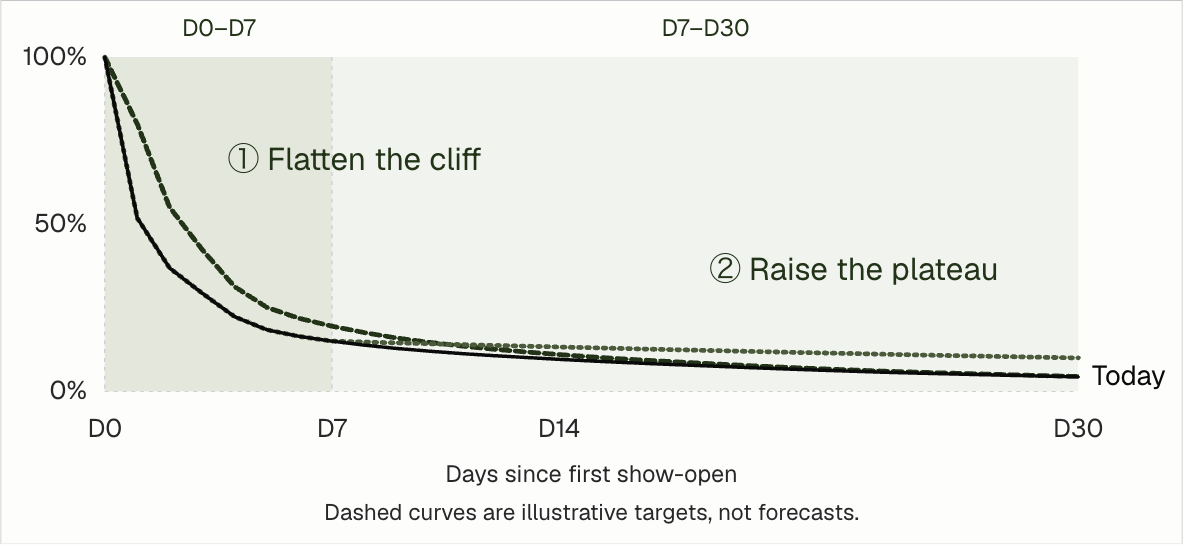
Two ways to improve Day-30 retention: flatten the early cliff or raise the later plateau, compared with today's curve. Dashed targets are illustrative, not forecasts.

Find the right trade-off between short-term value and LTV.

Compare how different recommendation strategies perform across CTR, activation, D7 retention, D30, and long-term retention.

CTRActivationD7 retentionD30 retention
A mobile phone with a forest-green Loopline notification extending beyond both edges: Pick up where you left off. Your next episode is ready.18:30LOOPLINEnowPick up where you left offYour next episode is ready.

Personalise notifications to drive lasting customer engagement

Serve each user the right message, at the right moment, with the right content, adapting continuously to downstream engagement, opt-outs, and retention.

MessageTimingContentRetention
Illustrative autoplay model: watch history, content features, and session context feed a trained ranker, which scores three videos and selects Video A to play next.Watch history, content features, and session context feed a trained ranker. It scores Video A at 0.82, Video B at 0.68, and Video C at 0.53, with Video A selected to play next. These scores are illustrative, not measured results.WatchhistoryContentfeaturesSessioncontextTrainedrankerVideo A0.82Video B0.68Video C0.53Play nextIllustrative

Optimise what plays next in an autoplay session

Continuously select the next best piece of content for each user, balancing watch time, completion, skips, and return behaviour.

Watch timeCompletionSkipsReturn behaviour

Security and trust

  • ISO 27001

    Certified

  • SOC 2 Type II

    Compliant

  • Encryption

    Encrypted in transit and at rest, with managed production keys.

  • Access control

    Least-privilege access, enforced with MFA and reviewed quarterly.

  • Data control

    Tenant-segmented, with retention and customer-controlled deletion.

  • Monitoring and response

    Continuously monitored, centrally logged, and ready to respond.

  • Tested and patched

    Independently pen-tested, scanned, and kept current against threats.

  • Resilient by design

    Multi-AZ with backups and a tested continuity and recovery plan.

Full reports, policies, and the complete control list are available on request through the Trust Center.

Start with one recommendation surface and one metric. Pavo helps your team understand the system, evaluate better approaches, and ship the first qualified experiment.